

New in InterSystems IRIS for Health 2026.2
This page describes the new features, enhancements, and other significant updates in the 2026.2 release of InterSystems IRIS® for Health, which is an extended maintenance (EM) release.
For other information you may wish to consider related to changes included in this release, see Known Issues and Notes. For a more exhaustive list of the changes included in this release, refer to the Upgrade ChecklistOpens in a new tab.
Release Information for 2026.2
The current release is 2026.2. The posting for 2026.2 is build 2026.2.0.221.0.
Healthcare Interoperability
The 2026.2 release introduces a new tool for building and testing FHIR queries against InterSystems IRIS for Health and third-party FHIR endpoints. The FHIR Explorer provides an interactive query builder, based on Capability Statements from EHR endpoints and FHIR Servers allowing users to run complex requests, test security configurations, and discover new capabilities with IntelliSense suggestions.
The FHIR JsonAdvSQL interactions strategy now implements the following behaviors:
-
REST clients can now use the HTTP Accept and Content-Type headers application/json, application/xml, application/fhir+json, and application/fhir+xml.
-
When paging search results with _include or _revinclude parameters, included resources will now appear on the same page as their matched result. This change in behavior is optional, and customers can retain the original paging implementation using the FHIR Server management user interfaces.
-
Read interactions on Binary resource-types will now return the Binary content directly if it matches the client’s HTTP Accept header. A full list of supported mime-types for this behavior is listed in the documentation.
New and existing FHIR Servers can be configured with the following behavior:
-
When enforcing OAuth-based flows, users can now define a list of accepted Audience values to be validated by a particular FHIR Server. This setting is available from the FHIR Server management pages and is necessary for validating tokens issued by third-party authorization servers including Entra ID, Okta, and Cognito that may use fixed aud parameters.
-
Users can now select options for bypassing FHIR structural validation during ingest. This setting is designed for large scale migrations to improve ingestion time and may result in malformed FHIR content being stored. Only disable structural validation if alternative controls are in place to ensure the structural integrity of your FHIR data.
-
Ingestion optimizations may improve FHIR ingestion speed by 25-30%.
Enhancing Analytics and AI
Using the Architect user interface, Business Intelligence users can define an analytical model that includes measures and dimensions directly based on the operational data structures. Previously, the interface leveraged relationship properties as captured in the class definition (an object-oriented development paradigm). Starting with the 2026.2 release, the interface now also allows you to leverage foreign keys, which are the recommended way to express such relationships when working in a relational paradigm, such as SQL. Since foreign key relationships may be based on more than one property, they are represented as a separate entry in the source data model tree with an “(FK)” suffix.
The integration between InterSystems IRIS for Health and the Apache UIMA framework was deprecated in 2023.1 because the open source project has been largely dormant, with no planned maintenance to address bugs or security vulnerabilities. For these reasons, InterSystems stopped including open source libraries that had been used as part of the integration in kits. After consultation with known users, the remaining entry points to use this integration in InterSystems IRIS for Health have now been removed from the platform entirely.
Enhancing Data Management and SQL
Table partitioning was introduced as an experimental feature in the 2026.1 release. The 2026.2 release improves some of its capabilities. The command for moving a partition to a target database, ALTER TABLE ... MOVE PARTITION, now supports non-default collation; it also correctly prevents the use of literals for the target database, supporting only identifiers. Additionally, an issue that caused conversions to fail if the partition key was on a field that had uppercase letters has been resolved.
InterSystems SQL supports both stored procedures and Common Table Expressions (CTEs). In the 2026.2 release, you may now use them together, creating a stored procedure that contains a CTE.
Enhancing Database Operations
The cvendian utility, used to migrate databases between big-endian and little-endian platforms, now achieves much faster conversion times (up to twice as fast) through appropriate use of large buffers to read and write database blocks. In addition, there is now enhanced error reporting when trying to mount a partially converted database (for example, if the cvendian process was interrupted and left the database in an inconsistent state).
Modernizing Interoperability User Interface
The following enhancements are included in InterSystems Interoperability-enabled products in the new user interface that continues to be an opt-in experience for most customers.
-
Improved visibility of the toggle options to switch between the Production Toolbar view and the Host Toolbar view.
-
Host actions are now present at all time in the Host Toolbar, even when a host is not selected. The actions are disabled until a host is selected and options are viable.
-
Added ability to enter multiple values in the Categories field with a comma-delimited list.
-
Added ability to rename an existing category.
-
When creating a new Process class, you can now configure a new Rule to automatically invoke source control actions, streamlining class export and source control integration workflows.
-
The Session Start message is now highlighted in green, reflecting the old behavior.
-
Added ability to copy raw message contents from the inspector panel.
-
Added an autocomplete feature on Source and Target fields of Message Search.
-
Visual Trace references to a rule in an activity now link to the link and open it in a new tab.
-
Added a column that indicates whether a message was resent in the messages table and in the message inspector to the Message Viewer.
-
Added ability to expand the message body, header, and contents sections at the same time.
-
Added a configurable notification feature that provides information when a search is started, in progress, and complete.
-
Added ability to edit a saved search and to save any edits as a new search.
-
Executing a saved search highlights the Saved Search icon, indicating an active saved search filter is in use.
-
Find your previously searched Message Search criteria SQL query in the Search History alongside the historical search’s run time and duration.
-
Message searching that use an active saved search now show the name of the saved search above the messages table.
-
Disabled extended search criteria during an active search to prevent adjustments.
-
Clicking the Extended Criteria icon in the toolbar now hides the dropdown; the Hide button is still available to hide the dropdown as well.
-
Added an indication (an asterisk) that you have changed the criteria of a previously executed saved search before executing the new, edited search.
-
Added ability to filter a trace by showing corresponding messages when right-clicking a message event.
-
Added ability to load new Visual Traces in a new tab without the message viewer, enabling sharing of session links.
-
Selecting two message activities now shows the time delta between the selected events.
-
Added boundaries for independent scrolling in the top panel of the graphical editor.
-
Added ability to alphabetically sort segment field path expressions.
-
Read-only and internal properties now appear greyed out in the DTL Editor to prevent invalid mappings.
-
Made the right-side inspector panel icon consistent with the show icon.
-
Added more padding on text within an activity shape and truncated characters for readability.
-
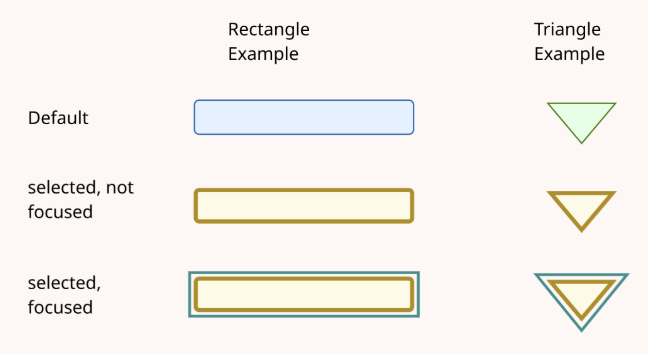
Enhanced multi-selected activity shapes and components when selected and focused. See an overview in the picture below.
-
Improved automatic rearrangement of activities by reducing the number of overlapping lines on lower level activity shapes.
-
Styled the Schema Viewer consistently across data standards.
-
Made HL7 schema segments expandable and collapsable.
-
Enhanced the HL7 Schema Segment Structure page to show the segment path of the selected segment.
-
Added type, search, and filter DocType and Source constraints in text fields.
-
Enhanced general usability be improving formatting and visuals, while also implementing and addressing various user-specific requests.
